Digital Bonjour Free Consultant
Chandigarh IT Park, India

Blog
Industrial Training That Helps in Career Branding: More Than Training, Building Careers That Stand Out.
The Future of Careers Requires More Than Just Certificates
The professional world is evolving rapidly. Businesses are becoming more digital, customer behavior is changing, and technologies such as Artificial Intelligence are transforming almost every industry. In this fast-moving environment, simply earning a degree or collecting certificates is no longer enough to stand out in the job market.
Today’s employers are seeking industry-ready candidates with practical skills, strategic thinking, problem-solving abilities, and the confidence to tackle real-world business challenges.
This is where industrial training plays a crucial role.
The right industrial training program does not merely teach software tools or theoretical concepts. It helps students understand industry expectations, develop practical expertise, and build a professional identity that distinguishes them from thousands of other candidates entering the market every year.
Modern industries demand professionals who are job-ready from the first day, and industrial training acts as the bridge between classroom education and professional success.
Why Career Branding Matters More Than Ever
Career branding refers to the process of creating a strong professional identity that showcases your expertise, skills, experience, and value proposition.
Employers today receive hundreds of applications for a single role. What makes one candidate stand out from the others is not just academic qualifications but their ability to demonstrate practical knowledge and measurable achievements.
A strong career brand helps professionals:
- Build credibility within their industry.
- Increase employability.
- Attract better job opportunities.
- Create freelancing possibilities.
- Establish authority in their field.
- Improve professional confidence.
- Differentiate themselves from competitors.
Industrial training becomes the foundation upon which this personal brand is built.
Industrial Training That Goes Beyond Traditional Learning
Many students graduate with excellent theoretical knowledge but limited exposure to actual industry practices.
They understand concepts but often struggle with practical implementation.
Traditional education frequently lacks:
- Industry exposure
- Live project experience
- Client communication skills
- Strategy development
- Analytical thinking
- Business understanding
Industrial training fills this gap by providing students with opportunities to work on real business scenarios and industry challenges.
Instead of simply learning “what digital marketing is,” students learn how businesses use digital marketing to generate leads, increase revenue, improve customer retention, and build long-term growth strategies.
This practical understanding becomes a major competitive advantage during interviews and professional assignments.
Designed for Students Who Want More Than Just a Certificate
Modern learners have different goals and ambitions.
Some students want internships that lead to placements. Others want to become freelancers, entrepreneurs, consultants, or international digital professionals.
Industrial training programs today must address these diverse career goals.
The program is suitable for:
- College students pursuing industrial training.
- Fresh graduates looking for their first job.
- Professionals planning a career transition.
- Business owners wanting to grow online.
- Freelancers seeking high-income digital skills.
- Homemakers planning to restart their careers.
- Entrepreneurs building personal brands.
Students from Chandigarh, Mohali, Panchkula, Zirakpur, Kharar, Punjab, Haryana, Himachal Pradesh, Delhi, and various parts of India increasingly seek training that delivers practical outcomes rather than theoretical lectures.
Their objective is simple:
To become industry-ready professionals capable of contributing immediately to business growth.
Digital Marketing with AI Prompts: Learning Skills for the Future
Artificial Intelligence is no longer a technology of tomorrow.
It is already shaping how businesses create content, run advertising campaigns, optimize websites, analyze customer behavior, and improve marketing performance.
However, successful professionals understand that AI is not replacing marketers.
Instead, AI is empowering marketers who know how to use it effectively.
One of the most valuable skills emerging in today’s market is prompt engineering and AI-assisted marketing workflows.
Students learn how to use AI for:
- Content creation
- Blog writing assistance
- Keyword research
- SEO optimization
- Advertisement creation
- Social media planning
- Market research
- Customer engagement
- Competitor analysis
- Email campaigns
- Performance reporting
The true value lies in understanding how to communicate with AI systems through effective prompts.
Well-written prompts produce better outputs, improve efficiency, reduce manual effort, and significantly increase productivity.
This combination of human creativity and AI assistance is becoming one of the most demanded skills in digital marketing.
Learning According to Current Industry Requirements
The digital industry changes constantly.
Search engine algorithms evolve.
Consumer expectations change.
Marketing channels emerge and disappear.
Strategies that worked five years ago may be completely ineffective today.
Therefore, industrial training must continuously adapt to current industry practices.
Modern learners need exposure to:
- Search intent analysis
- Semantic search optimization
- User experience signals
- Conversational search behavior
- AI-powered search environments
- Entity-based content strategies
- Content authority building
- Trust and expertise signals
- AI-assisted content evaluation
Learning outdated methods can damage long-term career growth.
Students benefit most when training focuses on strategies that businesses actively use in current projects and campaigns.
Universal SEO: Preparing Students for Global Opportunities
Search Engine Optimization has evolved significantly.
Earlier, businesses focused only on ranking locally.
Today, companies operate nationally and internationally, requiring marketers who understand multiple search environments and user behaviors.
Universal SEO training prepares professionals to work with businesses across different regions and industries.
Students develop expertise in:
Technical SEO
Understanding website structure, indexing, crawling, and optimization techniques.
On-Page SEO
Optimizing content, headings, metadata, images, internal links, and user experience.
Off-Page SEO
Building authority through backlinks, outreach strategies, and reputation management.
Local SEO
Helping businesses improve visibility in local searches and maps.
National SEO
Managing campaigns targeting broader audiences across entire countries.
International SEO
Optimizing websites for multiple countries, languages, and regions.
E-commerce SEO
Improving visibility and conversions for online stores and marketplaces.
AI-Assisted SEO
Using AI tools for keyword discovery, optimization recommendations, and content planning.
These skills significantly increase employability and freelancing opportunities.
Professionals capable of handling global projects often command higher salaries and access international clients.
Social Media Marketing with Strategy and Purpose
Anyone can post content on social media.
Very few people understand how to generate business results from it.
Modern organizations seek professionals who understand audience psychology, platform algorithms, content planning, and campaign optimization.
Social media marketing training focuses on:
- Content strategy
- Audience targeting
- Platform-specific approaches
- Organic growth techniques
- Brand storytelling
- Community management
- Engagement optimization
- Campaign performance analysis
- Lead generation strategies
- Paid advertising fundamentals
Students also learn how AI can support social media workflows through:
- Caption generation
- Content ideation
- Audience personas
- Campaign structures
- Content calendars
- Ad copy creation
AI improves speed and productivity, but creativity and strategic thinking remain essential human strengths.
The objective is to create marketers who can combine both effectively.
Practical Learning Creates Confident Professionals
One of the most common questions employers ask during interviews is:
“What practical experience do you have?”
Practical exposure often determines whether a candidate receives an offer letter or rejection.
Industrial training addresses this challenge by emphasizing hands-on learning.
Students work on:
- Live projects
- Industry case studies
- SEO audits
- Campaign simulations
- Reporting dashboards
- Strategy presentations
- Market research exercises
- Website optimization projects
- Client communication practices
Practical learning improves:
- Confidence
- Decision-making
- Analytical thinking
- Professional communication
- Problem-solving abilities
Students become comfortable handling real business situations rather than simply discussing theory.
Developing Skills That Employers Actually Value
Companies increasingly prioritize skills over qualifications.
While degrees remain important, employers place greater value on candidates who can demonstrate results.
Industrial training helps students develop highly sought-after competencies such as:
- Strategic thinking
- Communication skills
- Presentation abilities
- Data interpretation
- Performance analysis
- Creative problem-solving
- Team collaboration
- Project management
These skills often determine long-term career growth and leadership opportunities.
Building a Professional Portfolio
A certificate alone rarely convinces recruiters.
A portfolio of projects, campaigns, reports, and achievements provides stronger evidence of expertise.
Students are encouraged to build:
- SEO audit reports
- Content strategies
- Social media campaigns
- Keyword research projects
- Marketing plans
- Performance dashboards
- Case studies
A professional portfolio becomes one of the strongest career branding assets for interviews and freelancing opportunities.
Career Opportunities After Industrial Training
Digital marketing continues to be one of the fastest-growing industries globally.
Businesses across healthcare, education, manufacturing, retail, technology, finance, hospitality, and e-commerce require skilled digital professionals.
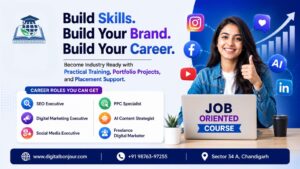
Career opportunities include:
- Digital Marketing Executive
- SEO Executive
- SEO Specialist
- Technical SEO Analyst
- International SEO Analyst
- Social Media Executive
- Social Media Strategist
- Content Marketing Executive
- Performance Marketing Executive
- PPC Specialist
- Email Marketing Specialist
- Marketing Analyst
- AI Content Strategist
- Prompt Specialist
- Growth Marketing Executive
- Content Writer
- Freelance Digital Marketer
- Marketing Consultant
Many professionals also choose entrepreneurship and build their own agencies, consulting businesses, or digital brands.
Freelancing and Global Opportunities
The rise of remote work has transformed the employment landscape.
Professionals can now work with businesses from multiple countries without relocating.
Digital marketers with expertise in SEO, content marketing, paid advertising, and AI-assisted workflows can build successful freelance careers serving clients worldwide.
Industrial training that includes international marketing concepts significantly improves these opportunities.
Freelancing offers:
- Flexible working hours
- Multiple income streams
- International exposure
- Higher earning potential
- Business ownership opportunities
Why Career Branding Starts During Training
Career branding does not begin after getting a job.
It begins during the learning process itself.
Students who actively build their skills, projects, communication abilities, and professional presence create stronger impressions in interviews and networking opportunities.
A strong career brand includes:
- Technical expertise
- Practical experience
- Professional communication
- Industry understanding
- Portfolio development
- Problem-solving skills
- Confidence
Employers hire professionals who inspire confidence and demonstrate value.
Industrial training provides the environment where these qualities develop naturally.
The Future Belongs to Adaptable Professionals
The future workplace will reward professionals who continuously learn and adapt.
Technology will continue evolving.
Artificial Intelligence will continue expanding.
Search behavior will continue changing.
The most successful professionals will be those who embrace innovation rather than resist it.
Digital marketers who combine creativity, strategy, analytical thinking, and AI capabilities will lead the industry over the next decade.
Our Thoughts For You
Industrial training should never be viewed as a formality required for academic completion.
It should be viewed as the first major investment in building a successful career.
The right training program helps students move beyond theoretical knowledge and develop the confidence, experience, and expertise needed to succeed in competitive industries.
More importantly, it helps create a professional identity that employers remember and trust.
Because great training does not simply teach skills.
Great training builds professionals.
And professionals who stand out build careers that stand the test of time.