Digital Bonjour Free Consultant
Chandigarh IT Park, India

AEO and GEO in 2026: The Complete Guide to Answer Engine Optimization and Generative Engine Optimization
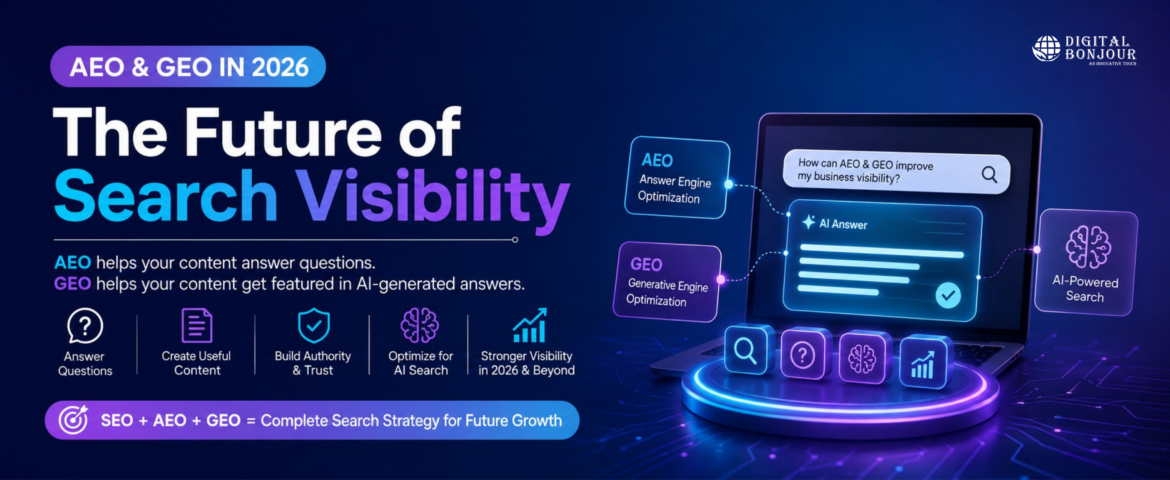
AEO and GEO: The Future of Search Visibility
Search is changing rapidly.
People are no longer relying only on traditional Google results to find information. They are asking longer, more conversational questions and increasingly using AI-powered search experiences to get direct answers.
This shift has created two important digital marketing strategies: Answer Engine Optimization (AEO) and Generative Engine Optimization (GEO).
Traditional SEO focuses heavily on helping web pages rank in search results. AEO focuses on helping content become a clear answer to a user’s question. GEO goes a step further by improving the chances that a brand’s content is discovered, referenced, or cited by AI-powered search and answer systems.
Google says the fundamentals of creating unique, useful, people-first content continue to apply to its AI search experiences, including AI Overviews and AI Mode.
For businesses, marketers, and website owners, this means SEO is not disappearing. It is expanding.
Let’s understand AEO and GEO, how they differ, and how you can prepare your website for the next generation of search.
What Is AEO?
AEO stands for Answer Engine Optimization.
It is the process of creating and structuring website content so that search engines and answer platforms can easily understand it and potentially use it to answer users’ questions.
For example, instead of searching:
“digital marketing course”
A user may search:
“What is the best digital marketing course for beginners?”
Or:
“How can a small business generate leads through digital marketing?”
These searches show a clear question or intent.
AEO aims to provide a direct, useful, and easy-to-understand answer.
How AEO Works
AEO-friendly content generally:
- Answers specific questions
- Uses clear headings
- Provides concise explanations
- Covers related questions
- Uses natural language
- Demonstrates expertise and trust
- Organizes information logically
- Supports important claims with reliable sources
The goal is simple:
Understand the question → provide the best answer → make the answer easy to find and understand.
What Is GEO?
GEO stands for Generative Engine Optimization.
GEO is the practice of optimizing content for AI-driven search and generative answer experiences.
AI systems may combine information from multiple sources to create an answer. Instead of simply showing ten blue links, an AI-powered experience can summarize information and provide supporting sources.
Microsoft has also introduced AI Performance reporting in Bing Webmaster Tools to show publishers when their pages are cited in AI-generated answers across experiences such as Microsoft Copilot and Bing’s AI-generated summaries.
This makes citations, relevance, clarity, authority, and useful information increasingly important for digital visibility.
AEO vs GEO: What’s the Difference?
Although AEO and GEO are closely connected, they are not exactly the same.
| AEO | GEO |
| Answer Engine Optimization | Generative Engine Optimization |
| Focuses on answering user questions | Focuses on visibility in AI-generated answers |
| Targets answer-based search experiences | Targets generative AI and AI-powered search |
| Emphasizes direct answers | Emphasizes relevance, authority, context and citations |
| Strongly connected to conversational search | Strongly connected to generative search |
Think of it this way:
SEO helps your website get discovered.
AEO helps your content answer questions.
GEO helps your content participate in AI-generated answers.
Together, they create a stronger modern search strategy.
Why Are AEO and GEO Important for Businesses?
The way people search is becoming more conversational.
A potential customer might not search for:
“SEO agency Chandigarh.”
Instead, they could ask:
“Which SEO agency in Chandigarh can help a local business improve Google visibility?”
The second query reveals more intent.
This creates opportunities for businesses that publish detailed, useful, and well-structured content.
Google recommends focusing on unique, satisfying content for people and ensuring that websites are technically accessible, easy to navigate, and capable of supporting different search formats.
GEO is also becoming measurable. Bing’s AI Performance tools can show which URLs are cited in AI answers and provide information about the queries associated with those citations.
10 Practical AEO Strategies for Your Website
- Target Real Questions
Start with the questions your customers actually ask.
For example, a digital marketing company could create content around:
- What is digital marketing?
- How does SEO work?
- What is local SEO?
- How much does SEO cost?
- What is AEO?
- What is GEO?
- How can businesses use AI for marketing?
- How can a small business generate leads online?
These questions can become blog topics, FAQs, service-page sections, and supporting content.
- Give Direct Answers
Don’t make readers search through long paragraphs to find a simple answer.
Start sections with a clear explanation and then provide additional details.
For example:
What is AEO?
AEO is the process of optimizing content so that search engines and answer platforms can understand and potentially use it to answer user questions.
Then expand with examples, benefits, strategies, and related information.
- Use Question-Based Headings
Question-based headings naturally match conversational searches.
Examples include:
- What is AEO?
- How does GEO work?
- Why is GEO important for SEO?
- How can businesses optimize content for AI search?
- What is the difference between SEO, AEO and GEO?
This creates a logical structure for both users and search systems.
- Build Topic Depth
One article should not try to rank for hundreds of unrelated keywords.
Instead, create a group of connected content around a central topic.
For example:
Main topic: Digital Marketing
Supporting topics:
- SEO
- Local SEO
- Technical SEO
- Content Marketing
- Social Media Marketing
- AEO
- GEO
- AI Marketing
- Google Business Profile
This helps establish topical relevance and gives users more useful resources.
- Use Structured Data Where Appropriate
Structured data gives search engines additional information about the content of a webpage.
Google explains that structured data provides explicit clues about the meaning and classification of page content and can make pages eligible for certain search features.
However, structured data should not be treated as a shortcut to rankings.
Use appropriate schema markup and ensure that it accurately represents the visible content on your page.
- Create Strong FAQ Sections
FAQ sections can improve usability by answering common questions in one place.
For example:
Is AEO replacing SEO?
No. AEO is better understood as an extension of modern search optimization. Traditional SEO remains important for crawling, indexing, relevance, and visibility.
One important update: Google has limited FAQ rich-result visibility primarily to well-known authoritative government and health websites, so adding FAQ schema does not guarantee a Google FAQ rich result for a typical business website.
The FAQ content can still be valuable for users and content organization.
- Improve E-E-A-T Signals
AI systems need useful and trustworthy information.
Strengthen your website by showing:
- Author information
- Business information
- Industry experience
- Original insights
- Case studies
- Examples
- References
- Accurate statistics
- Updated information
Don’t simply rewrite what other websites have already published.
Add something useful.
- Support Claims With Evidence
If you make an important claim, explain where the information comes from.
Use:
- Government sources
- Official documentation
- Industry research
- Original data
- Expert commentary
- Reputable publications
Bing’s guidance specifically recommends supporting claims with evidence and improving content clarity and structure when considering visibility in AI-generated answers.
- Keep Content Fresh
AI search is constantly evolving.
Your website should evolve too.
Review important content regularly and update:
- Statistics
- Tools
- Examples
- Screenshots
- Industry trends
- Product information
- Search guidelines
- Dates and references
Freshness is particularly important for subjects such as AI, SEO, digital marketing, technology, and advertising.
- Don’t Forget Technical SEO
AEO and GEO do not eliminate technical SEO.
Your website still needs to be:
- Crawlable
- Indexable
- Mobile-friendly
- Fast
- Secure
- Well structured
- Internally linked
- Free from major technical errors
Google’s Search Essentials continue to emphasize technical requirements, spam policies, and key best practices for appearing in Search.
Bing similarly states that traditional SEO foundations support eligibility for AI-powered search and grounding experiences.
How to Optimize Content for GEO
GEO requires thinking beyond individual keywords.
Instead, ask:
Would an AI system consider this page a useful, trustworthy source for answering a specific question?
Here are some practical approaches.
Create Comprehensive Content
Cover the topic from multiple relevant angles.
If you’re writing about SEO, don’t only define SEO. Explain:
- How SEO works
- Types of SEO
- SEO benefits
- SEO mistakes
- SEO tools
- SEO strategies
- Local SEO
- Technical SEO
- Measuring SEO performance
This creates a stronger knowledge resource.
Use Clear Entities and Context
Be specific.
Instead of saying:
“It helps businesses improve visibility.”
Say:
“Local SEO helps businesses improve their visibility in location-based Google searches and Google Business Profile results.”
Clear language reduces ambiguity.
Maintain Consistency
Your website, Google Business Profile, social profiles, images, videos, and other business information should communicate consistent information.
Bing recommends aligning text, images, and video so they consistently represent the same entities, products, and concepts.
Build Brand Authority
GEO isn’t only about optimizing individual pages.
Your overall online presence matters.
Build authority through:
- High-quality website content
- Industry publications
- Digital PR
- Relevant backlinks
- Expert contributions
- Reviews
- Case studies
- Social media presence
- Business profiles
The objective is to become a recognizable and credible source within your niche.
AEO and GEO Keyword Strategy
Your keyword strategy should now include more than short keywords.
Traditional Keywords
- Digital marketing agency
- SEO services
- Digital marketing course
- Local SEO services
AEO Keywords
- What is digital marketing?
- How does SEO work?
- How can local SEO help a business?
- What is AEO?
- How does GEO work?
Conversational Keywords
- How can I get more leads from Google?
- What is the best SEO strategy for a small business?
- How can a local business improve online visibility?
GEO-Focused Content
Create resources that answer broader questions and provide original, trustworthy information that AI systems can understand and reference.
Is AI-Generated Content Good for AEO and GEO?
AI can be useful for research, brainstorming, outlining, and improving content workflows.
But publishing large amounts of generic AI-generated content without adding meaningful value is risky.
Google’s guidance states that generative AI can be useful for research and structuring original content, but generating many pages without adding value can violate its scaled content abuse policy.
The better approach is:
AI-assisted + human expertise + original research + real examples + useful insights.
Don’t create content simply because AI makes publishing faster.
Create content because it helps your audience.
How Digital Bonjour Can Help
At Digital Bonjour, we understand that digital marketing is moving beyond traditional search rankings.
Modern businesses need a strategy that combines:
SEO + Content Marketing + AEO + GEO + AI + Digital Branding
Our approach focuses on creating useful digital experiences that help businesses improve visibility, attract relevant audiences, and build long-term online presence.
Whether your goal is to improve local visibility, generate leads, build brand authority, or prepare your website for AI-powered search, a strong content and SEO foundation is essential.
The Future of Search Is Answer-Driven
The search journey is becoming more conversational, contextual, and AI-powered.
That doesn’t mean traditional SEO is dead.
It means the definition of search visibility is becoming broader.
A successful website should be:
Easy to crawl.
Easy to understand.
Easy to navigate.
Useful to people.
Relevant to questions.
Trustworthy enough to reference.
AEO and GEO should therefore be viewed as extensions of a strong SEO strategy—not replacements for it.
Final Thoughts
The future of digital marketing belongs to businesses that understand how people search, how search engines understand content, and how AI systems discover and reference information.
AEO helps your content answer questions.
GEO helps prepare your content for generative search experiences.
SEO provides the technical and content foundation connecting everything together.
The winning strategy is not to write content exclusively for Google or AI.
Write genuinely useful content for people—and structure it so machines can understand it too.
That is the foundation of modern search visibility.
Frequently Asked Questions About AEO and GEO
What is AEO in digital marketing?
AEO, or Answer Engine Optimization, is the practice of structuring and optimizing content to provide clear answers to users’ questions across search and answer-based experiences.
What is GEO in SEO?
GEO, or Generative Engine Optimization, focuses on improving the likelihood that a website’s information can be discovered, referenced, or cited within AI-generated search experiences.
Is GEO replacing SEO?
No. GEO builds on many traditional SEO fundamentals, including crawlability, indexing, content quality, relevance, authority, and technical accessibility.
How can I optimize my website for AEO?
Create question-focused content, provide direct answers, use descriptive headings, cover related topics, improve readability, demonstrate expertise, and maintain strong technical SEO.
How can I improve GEO visibility?
Create original and trustworthy content, clearly explain concepts, support claims with evidence, build topical authority, maintain consistent business information, and keep important pages updated.
Does AI-generated content rank on Google?
AI-generated content is not automatically disqualified. However, Google emphasizes useful, original, people-first content and warns against scaled content created primarily to manipulate search rankings.
Should businesses invest in AEO and GEO in 2026?
Yes. As search experiences increasingly incorporate AI-generated answers, businesses should optimize for traditional search while also making their content clear, useful, structured, authoritative, and easy for AI systems to interpret.
Digital Bonjour — Building Smarter Digital Visibility for the AI Search Era.


Leave A Comment